
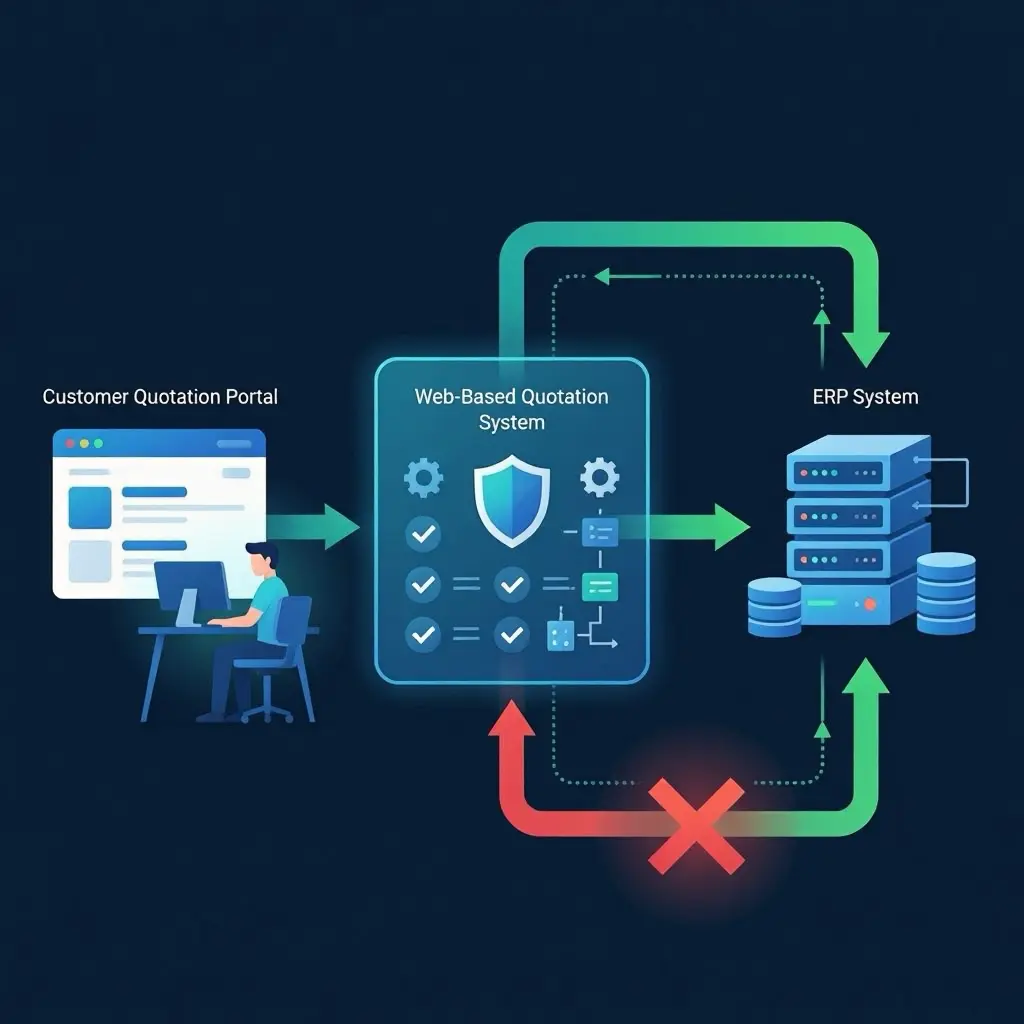
Many manufacturers and distributors are exploring online quotation systems — a smart move for reducing sales overhead and serving customers faster. But there is one architectural decision that can turn a smart initiative into a serious liability: connecting your public-facing quotation form directly to your ERP system.
It seems logical on the surface. Your ERP holds pricing data, product configurations, and inventory levels — so why not query it directly when a customer submits a request? The answer involves security, performance, compliance, and business control. This article explains why a dedicated web-based quotation system must always act as the buffer between your customers and your ERP — and what the right architecture looks like.
The Hidden Risks of Direct ERP Exposure
Your ERP is the operational brain of your business. It holds pricing structures, supplier costs, customer contracts, inventory data, financial records, and often payroll or HR information. Exposing it to public web input — even indirectly — dramatically increases your attack surface.
What Can Go Wrong
- SQL Injection and Data Manipulation: A malicious user submitting crafted input through a public form can potentially query or corrupt your ERP database if input is passed through without validation.
- Unauthorized Pricing Access: Direct ERP queries may expose more pricing data than intended — including cost prices, margin structures, or competitor-specific contract rates.
- Credential and API Key Exposure: Direct integrations often require ERP credentials to be stored in the web application layer, where they become a target for attackers who compromise your web server.
- ERP System Crashes from Web Traffic: ERP systems are engineered for internal users — typically tens to hundreds of concurrent sessions. A spike in public web traffic can overwhelm the system, causing downtime that halts your entire operation.
Consider a real-world scenario: a distributor builds a simple online pricing calculator that queries their cloud ERP directly. A competitor — or an automated bot — hammers the endpoint with thousands of requests overnight, extracting a full product and pricing catalogue. By morning, your confidential pricing strategy is in the wrong hands.
The Right Architecture: Decoupling Frontend from Backend
Enterprise system architecture best practice is clear on this point — your public-facing application layer should never have direct read or write access to your core business systems. This principle is called decoupling, and it is the foundation of secure, scalable web application design.
The correct architecture for a web-based quotation system looks like this:
Recommended Secure Workflow
(Web Form) → Quotation System
(Validation & Rules) → Secure API
(Controlled Access) → ERP System
(Pricing Output)
In this model, the quotation system acts as a security buffer. It accepts public input, applies business rules, validates data, and only then communicates with the ERP through a tightly controlled API with limited, read-only permissions. The ERP never sees raw public input — only clean, validated, authorised requests.
Why Data Validation and Middleware Logic Are Non-Negotiable
Before any data reaches your ERP, it must pass through a validation and processing layer. This is not optional — it is what keeps your system safe and your pricing accurate.
- Input Sanitisation: Strip malicious characters, enforce data types, and reject unexpected values before they travel anywhere near your ERP.
- Business Rule Enforcement: Apply minimum order quantities, product configuration logic, and customer tier validation at the application layer — not inside the ERP.
- Rate Limiting and Abuse Prevention: Throttle requests per user or IP address to prevent automated scraping of your pricing catalogue.
- Audit Logging: Every quote request is logged with user identity, timestamp, and inputs — giving you a complete trail for compliance and dispute resolution.
ERP Systems Are Not Built for Public Traffic
This is a point many IT managers discover too late. ERP platforms — whether SAP, Oracle, Microsoft Dynamics, or local Malaysian ERP systems — are designed for internal enterprise use. They are optimised for transactional accuracy and data integrity among a controlled number of concurrent users, not for handling unpredictable public web traffic.
When you expose an ERP to public load, you risk:
- Slow response times that frustrate customers and damage your brand
- Resource contention that degrades performance for internal users simultaneously
- Licensing violations, as most ERP vendors charge per named or concurrent user
- Cascading system failures that affect invoicing, inventory, and fulfillment operations
A purpose-built web quotation system, by contrast, is designed to handle spikes in traffic gracefully — scaling independently without touching your ERP until a validated, approved request is ready to be processed.
Business Logic Flexibility: Your Competitive Advantage
Every manufacturer and distributor has pricing logic that is more complex than a simple lookup table. Volume discounts, customer-specific rates, bundled configurations, promotional pricing, currency conversion, and delivery surcharges all need to be calculated before a final quote is produced.
Embedding this logic inside an ERP is rigid and difficult to change. Building it into a dedicated quotation system gives you full control:
- Sales managers can update pricing rules without touching the ERP
- New product configurations can be added without an ERP upgrade cycle
- Promotional pricing can be activated and deactivated instantly
- Different rules can apply to different customer segments, markets, or regions
This flexibility is what turns a quotation system from an administrative tool into a strategic sales asset.
Compliance and Data Privacy Under Malaysian Law
Under the Personal Data Protection Act (PDPA) Malaysia, businesses are required to protect personal data collected from individuals — including names, company details, and contact information submitted through web forms. Routing this data directly into an ERP without proper controls creates compliance exposure.
A properly architected quotation system handles PDPA compliance at the application layer: consent collection, data minimisation, secure transmission, and access logging — all before data reaches the ERP. This is far easier to audit and demonstrate to regulators than tracing data flows through an ERP directly.
What a Properly Built Quotation System Looks Like
A well-designed web-based quotation system delivers the following for manufacturers and distributors:
- A secure customer portal with role-based access — each customer sees only their authorised products and pricing tier
- A calculation engine that applies your business rules before any ERP communication occurs
- A controlled API layer that connects to your ERP with minimum necessary permissions
- Branded PDF quote generation — professional output delivered instantly, without manual sales team involvement
- A complete audit trail of every quote, every user, and every pricing decision
This is not just a convenience feature. It is the architecture that allows your business to scale its sales capacity without scaling its risk.
Build It Right From the Start
If your business is considering an online quotation system, the architecture decisions made at the outset will determine whether the system becomes a competitive asset or a security liability. Our team designs and builds web-based quotation portals specifically for Malaysian manufacturers and distributors — with ERP integration, security-first architecture, and business logic built for how you actually price.
Learn about our Web-Based Quotation System service →